Every practice website has to satisfy two very different visitors. The first is the patient, who judges you in seconds on how the site looks and feels. The second is Google, which can’t see “beautiful” at all; it reads structure, text, links, and code. Most agencies design beautifully for the first visitor and forget the second entirely. The result is a gorgeous brochure that no one ever finds.
If your site looks great but ranks nowhere, it’s almost always one of these structural problems.
1. You don’t have real service pages
Google ranks pages, not practices. If everything you offer is crammed onto one scrolling homepage, or buried in a single “Services” page with a paragraph each, you’ve given Google nothing specific to rank. A practice that wants to rank for “dental implants,” “root canals,” and “teeth whitening” needs a dedicated, substantial page for each, written around how patients actually search for it. One thin page can’t compete with a competitor who built three focused ones.
2. Your heading structure is decorative, not logical
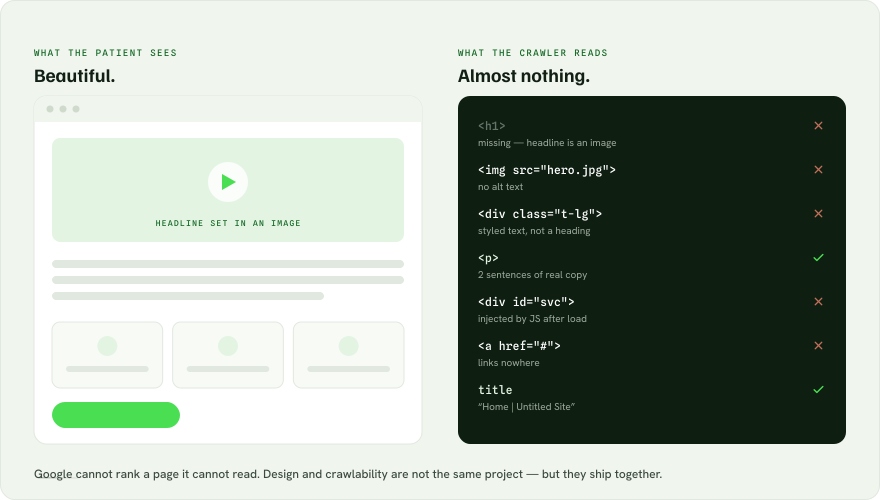
Headings (the H1, H2, H3 tags in your code) are how Google understands the hierarchy of a page. When headings are chosen for how big the text looks rather than what the content means (three H1s here, a styled paragraph standing in for a heading there), you blur the signal. A clean, logical heading structure tells Google exactly what each page is about. A decorative one tells it nothing.
3. Google literally can’t read your content
Some beautiful sites hide their actual content from search engines without anyone realizing it: text baked into images, content that only loads after heavy scripts run, or “designs” where the real words are sparse and the visuals do all the talking. If Google can’t crawl and parse your text, it can’t rank you for it. Looking good to a human and being readable to a crawler are two different problems.
4. It’s slow, or it isn’t built mobile-first
Most patient searches happen on a phone, and Google measures the real-world experience through Core Web Vitals: load speed, responsiveness, and visual stability. A heavy, slow site loses patients before it even appears and gets quietly demoted in the process. “It looks fine on my laptop” is not the test that matters.
5. There’s no internal linking
Internal links (the links between your own pages) tell Google which pages matter and how your expertise connects. Many practice sites are a flat pile of disconnected pages, so authority has no way to flow to the pages that drive bookings. Deliberate internal linking is one of the most underused, highest-leverage things you can do on a site.
6. There are no location signals
A medical practice lives and dies by local search, yet many sites barely mention where they are or whom they serve beyond a footer address. Without clear service-area structure, Google struggles to connect you to “near me” and city-level searches, the exact ones with patients ready to book.
7. There’s no structured data
Structured data (schema markup) is extra code that spells out, in a language Google trusts, what your practice is, what services you offer, and where you’re located. Without it, you’re asking Google to infer everything. With it, you make its job easy, and earn richer, more confident placement in results.
A pretty site that nobody finds doesn’t grow a practice. Looks get a patient to stay; structure is what gets them there in the first place.
How to tell if your site has the problem
A few quick gut checks:
- Search for your top service plus your city. Are you on page one? Be honest.
- Count your real service pages. Is there a dedicated, substantial page per major service?
- Open your site on your phone on cellular data. Does it load fast and behave?
- Right-click and “view page source.” Can you actually find your key content as text?
If those answers sting, the issue isn’t your design taste; it’s the structure underneath it.
The fix
You don’t have to choose between a site that looks great and one that ranks. The fix is to build on a structure that’s engineered for search from the start, then make it beautiful on top of that foundation: proper service pages, a clean heading hierarchy, fast mobile-first performance, deliberate internal links, real location signals, and structured data. That’s exactly what the LaunchMD Framework site is, and it’s why we treat the website as the foundation the rest of your growth is built on.
Looks bring patients back. Structure is what gets them to you in the first place. You need both.