Reviews are one of the strongest signals in local search. They influence where you land in the Map Pack, and they’re often the deciding factor when a patient is choosing between you and the practice next door. So the instinct to chase a number makes sense. It’s just the wrong number.
Why “how many reviews” is the wrong first question
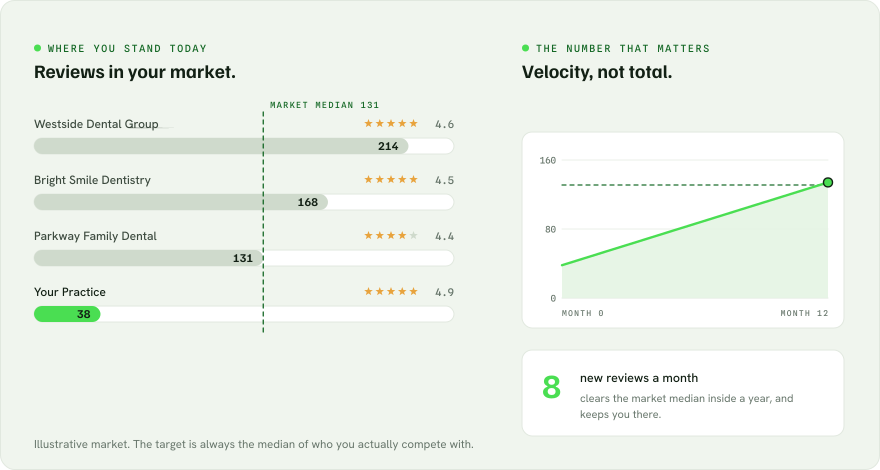
A fixed target (“get to 100 reviews”) assumes reviews work in a vacuum. They don’t. What matters is how you compare to the practices you’re actually competing against for the same searches. Two hundred reviews sounds impressive until the three practices ranking above you each have four hundred. Fifty reviews can be plenty in a market where your competitors have fifteen.
So the real target isn’t a round number. It’s this: more and better reviews than the competitors ranking above you for your key searches. That’s the bar that actually moves you up.
Velocity matters more than the total
Here’s what surprises most practice owners: a steady flow of new reviews often matters more than your all-time total. Google favors practices that look active and current. A clinic earning a handful of fresh reviews every week reads as thriving; one with two hundred reviews that all stopped eighteen months ago reads as coasting or, worse, declining.
This is review velocity, and it’s the metric to obsess over. A consistent, recent stream beats a big pile of old reviews almost every time.
Stop asking “how many reviews do we have?” Start asking “how many did we earn this month?”
The star-rating sweet spot
Rating matters too, but not the way people assume. The instinct is to chase a perfect 5.0, yet a flawless score across hundreds of reviews can actually read as too good, making prospective patients suspicious. Research on consumer behavior consistently points to a sweet spot a little below perfect, roughly in the 4.2 to 4.9 range, where the score is excellent and believable. A few thoughtful, well-handled less-than-perfect reviews can make the great ones more credible, not less.
The goal isn’t perfection. It’s a strong, trustworthy rating backed by enough recent volume that patients believe it.
Reviews now feed AI answers, too
There’s a newer reason to care about reviews: AI-powered search. When a patient asks an AI assistant or sees a Google AI Overview for “best [specialty] near me,” those systems frequently lean on review signals (ratings, volume, recency, and even the language inside reviews) to decide which practices to name. A thin or stale review profile doesn’t just cost you in the Map Pack anymore; it can cost you the AI citation entirely. (More on that in how patients find you when AI answers first.)
How to get there without crossing HIPAA lines
For a medical practice, growing reviews is more delicate than it is for a restaurant. The wrong request can expose protected health information or run afoul of professional rules. The way to grow safely:
- Ask everyone, consistently. The biggest lever is simply requesting a review after every visit, every time, not occasionally, not only from your favorite patients.
- Ask at the right moment. Requests sent right after the visit, while the experience is fresh, convert far better than ones sent days later.
- Keep it generic. Never reference a diagnosis, treatment, or visit detail in a request. Keep the language about the overall experience.
- Make it one tap. Every extra step between “sure” and a posted review loses people.
- Never screen first. Asking how the visit went and sending only happy patients to Google is review gating, which Google’s policies prohibit. Everyone gets the same link.
Done by hand, this is exactly the kind of thing a busy front desk forgets. That’s why we built the Reputation Builder: HIPAA-conscious requests your staff send in one tap at checkout, plus a review link and QR code, so velocity becomes something you can count on instead of hope for.
So, what’s the number?
If you need one to aim at: get ahead of the competitors ranking above you, then never stop. The practices that win on reputation aren’t the ones that hit a target and relaxed; they’re the ones that turned reviews into a system and kept the stream flowing, month after month.