When a patient searches for care, Google answers with a map and three highlighted businesses. That block is the Map Pack (sometimes called the “local pack” or “3-pack”), and it absorbs the lion’s share of clicks and calls for local searches, often before anyone scrolls to a single website. If you’re not in those three, you’re effectively invisible for the searches that matter most, no matter how good your care is.
The good news: Map Pack ranking is driven by a known set of signals. When a practice isn’t showing up, it’s almost always one (or a few) of the reasons below.
1. Your primary category is wrong, or too generic
Your Google Business Profile’s primary category is the single strongest relevance signal you have, and it’s the field practices get wrong most often. A cosmetic dentist listed only as “Dentist” is competing in a far broader, more crowded pool than one correctly listed as “Cosmetic Dentist” with the right secondary categories layered in.
If you haven’t deliberately chosen your primary category against the exact searches you want to win, assume it’s costing you.
2. Your profile is incomplete
Google rewards complete, active profiles and quietly demotes neglected ones. Missing services, no attributes, thin or outdated photos, wrong hours, an unverified profile: each gap is a reason for Google to trust a more complete competitor instead. Completeness isn’t busywork; it’s a ranking input.
3. You don’t have enough recent reviews
Reviews are one of the most powerful local ranking signals, and recency matters as much as volume. A practice with a steady stream of new reviews looks active and trusted; one with forty reviews that all stop two years ago looks dormant. If your competitors are collecting reviews every week and you’re collecting them by accident, the gap compounds.
We go deeper on the actual numbers in how many Google reviews your practice really needs.
4. Your name, address, and phone aren’t consistent everywhere
Your NAP (Name, Address, Phone) needs to be identical across Google, your website, and every directory you appear in. When an old suite number lingers on one listing and a previous phone number on another, Google loses confidence that it knows who and where you are, and confidence is exactly what ranking requires. Inconsistent citations are one of the most common silent killers of local visibility.
5. The website behind your profile is weak
The Map Pack doesn’t exist in isolation. Google leans on the authority and relevance of the website your profile links to. If that site is slow, thin, or structured so Google can’t tell what you do and where, it drags your profile down with it. A profile can only carry you so far when the foundation under it is cracked, which is why we treat the SEO website and the profile as one system.
6. Proximity: the one factor you can’t change
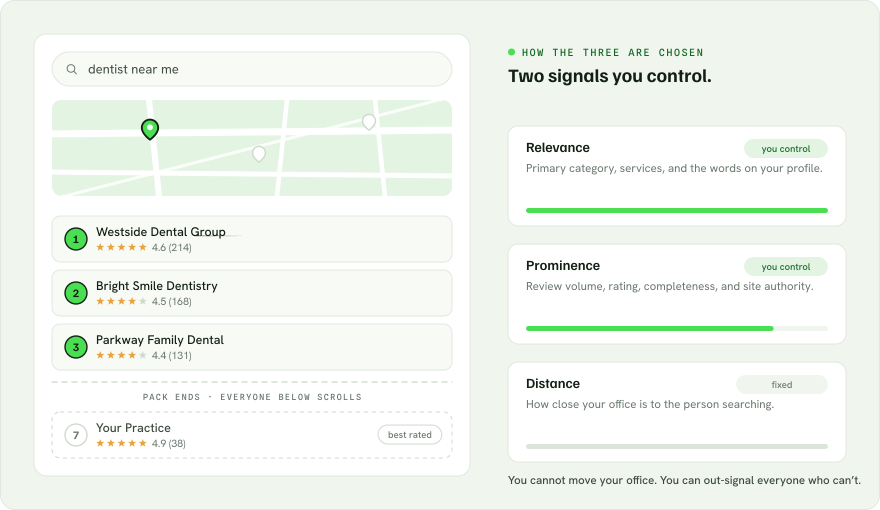
Distance between the searcher and your office genuinely affects local ranking, and you can’t move your building. But proximity is only one of three core factors (alongside relevance and prominence). Practices often blame distance when the real problem is a weak category, thin reviews, or messy citations. Sharpen everything you can control and you’ll win across a meaningfully wider radius.
Where to actually start
If you want to move the needle, work in this order:
- Claim and fully verify your Google Business Profile.
- Fix your primary category and build out secondary categories and services.
- Complete every field: attributes, hours, services, current photos.
- Audit your NAP across the web and correct inconsistencies.
- Turn reviews into a consistent, recent stream instead of a trickle.
- Make sure the website behind the profile is fast and clearly structured.
Most “invisible” practices aren’t losing to better marketing; they’re losing to a competitor who simply set the basics up correctly and kept them active.
The honest timeline
Profile and category fixes are direct relevance signals, so they can move within the first several weeks. Review growth and website authority build over the following months, but because organic visibility compounds, the position you earn keeps working long after the work is done. The practices that win the Map Pack are rarely the ones with the biggest budget; they’re the ones who treated it as a system instead of a one-time setup.