For twenty years, “being found online” meant one thing: ranking in the list of blue links. That era is ending. Search is splitting into three overlapping jobs, and a practice that only does the first is quietly losing ground on the other two.
From “ten blue links” to “one answer”
When someone searches “do I need a root canal or a filling?” they used to get ten links to read and compare. Now they often get a single, synthesized answer at the top of the page, and a meaningful share of people never click past it. The question for your practice is no longer just “do we rank?” It’s “are we the source the answer is built from?”
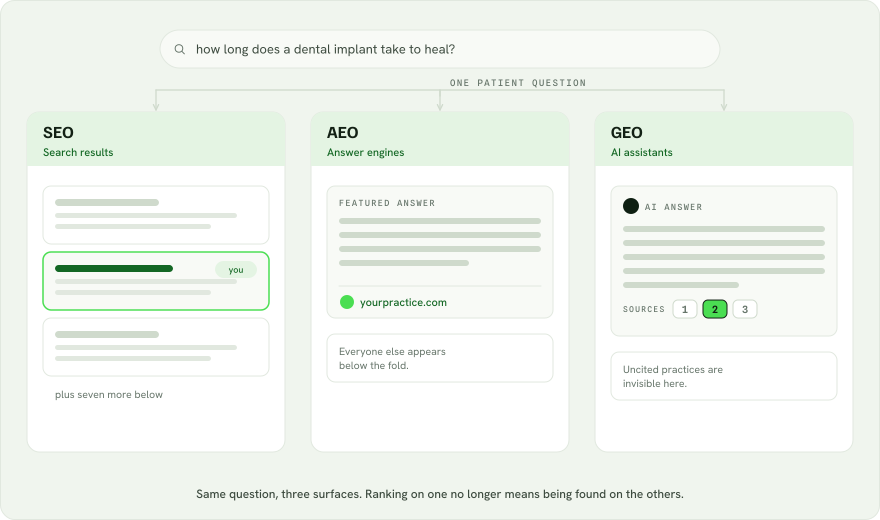
SEO, AEO, GEO: what they actually mean
- SEO: Search Engine Optimization. The classic discipline: earning rankings in the traditional list of results and the local Map Pack. Still essential; still where a lot of patient intent lives.
- AEO: Answer Engine Optimization. Optimizing to be the answer: the featured snippet, the voice result, the boxed response that resolves a question without a click.
- GEO: Generative Engine Optimization. Optimizing to be surfaced and cited inside AI-generated answers: Google’s AI Overviews and AI assistants that compose a response from many sources.
They’re not three separate marketing campaigns. They’re three lenses on the same goal (being the trusted source), and they’re won with the same underlying asset: genuinely good, well-structured content.
What AI engines actually cite
Generative systems don’t pick sources at random. The patterns in what they cite are remarkably consistent with what good SEO has always rewarded, just sharper:
- Clear, direct answers. Content that answers a specific question plainly, near the top, is far easier for an engine to lift and attribute than the same point buried in a wall of text.
- Genuine authority and accuracy. For health topics especially, engines favor sources that demonstrate real expertise and get the facts right; they’re cautious about citing thin or questionable medical content.
- Structure it can parse. Logical headings, concise definitions, and question-and-answer formatting make your content extractable. Decorative structure makes it invisible.
- Consistency across the web. When your name, specialty, location, and services line up everywhere, engines grow confident about who you are, and confident sources get cited.
- Reputation signals. Ratings, review volume, and recency feed AI’s sense of which local practices to name. (We dig into this in how many reviews your practice really needs.)
The content strategy that wins all three
You don’t chase SEO, AEO, and GEO with three different tactics. You build content that’s good enough to win all three at once. In practice, that means:
Answer real patient questions, directly
The questions patients actually type (“is a dental implant painful?”, “how long is recovery after a cyst removal?”, “what’s the difference between a dermatologist and an esthetician?”) are exactly what answer and generative engines are built to respond to. Publish clear, accurate answers to those questions and you become eligible to be the answer. Skip them and you’re not even in the running.
Structure content to be extracted
Lead with the answer, then explain. Use descriptive headings that match how people ask. Keep key definitions tight and quotable. Add FAQ sections and structured data so engines can confidently map a question to your response. You’re not writing for a robot; you’re writing clearly enough that a robot can tell you were clear.
Build depth, not one-off posts
A single article is a drop. Covering a topic thoroughly (the procedure, the recovery, the costs, the comparisons, the concerns) signals topical authority, and authority is what makes both Google and AI engines treat you as the local source for your specialty. Depth published consistently compounds; one clever post does not.
Keep it accurate, because health content is held to a higher bar
Search engines apply stricter standards to “Your Money or Your Life” topics, and health is the canonical example. Medically reviewed, trustworthy content isn’t just good ethics; it’s the price of admission to being cited. Content that overpromises or cuts corners gets filtered out exactly when the stakes are highest.
You can’t trick your way into an AI answer. You earn the citation the same way you earn trust: by being clearly, demonstrably, consistently the best source.
Why this is strategy, not a trick
It’s tempting to treat AEO and GEO as new hacks to game. They aren’t. The throughline from classic SEO to generative search is that quality, clarity, structure, and authority keep winning; the surfaces just change. A practice that publishes accurate, well-structured answers to the questions its patients actually ask will show up in the blue links, the answer boxes, and the AI responses, because all three are reaching for the same thing.
That’s the entire idea behind our Content System: medically reviewed, keyword-researched articles, built to be found and cited, published consistently so your authority compounds across every surface where patients now search, including the ones that answer before they ever show a link.