Content only works when it answers what people are actually searching for. A clever post about a topic no one queries earns nothing; a plain, helpful answer to a question hundreds of patients type every month can bring in bookings for years. So the entire game is finding the real questions, and there are more sources for them than you’d think.
Stop guessing, start listening
The mistake practices make is brainstorming topics in a conference room, disconnected from real demand. You end up writing what you find interesting, not what patients are searching. Flip it: treat content like a transcription of the questions your patients already ask, and you’ll never run dry, or waste a post on something nobody wants.
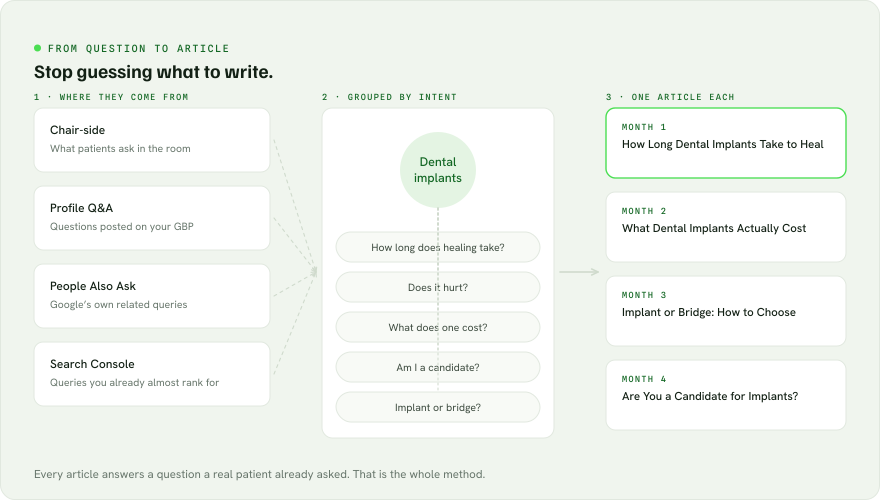
Where the questions are hiding
- Your front desk. The questions patients ask when they call or check in (“does this hurt?”, “will my insurance cover it?”, “how long is recovery?”) are pure gold. Your team hears them every day. Each one is a post.
- Google autocomplete & “People also ask.” Start typing your service into Google and watch the suggestions. Scroll to the “People also ask” boxes. That’s Google handing you the exact phrasing of what people search around your topic.
- Your reviews and FAQs. Recurring themes in reviews and the questions you answer over and over by email reveal what patients care about before and after a visit.
- Competitor gaps. Look at what the practices outranking you have covered and, more usefully, the questions they’ve answered badly or not at all. Those gaps are your fastest wins.
Sort questions by where the patient is in their journey
Not every question is worth the same to your practice. A useful way to prioritize is by intent:
- Awareness: “why does my jaw click?” The patient has a problem but hasn’t decided to act. Helpful, trust-building, top-of-funnel.
- Consideration: “Invisalign vs. braces for adults.” They’re weighing options. This is where you demonstrate expertise and shape the decision.
- Decision: “cost of dental implants in [your city].” They’re close to booking. These posts convert hardest, so they’re often worth writing first.
A healthy content plan covers all three, but if you’re starting out, weight it toward decision-stage questions; they bring in patients who are ready now.
You will never run out of things to write about. You’ll only run out if you keep guessing instead of listening to the questions patients are already asking.
Build clusters, not random posts
A pile of unrelated articles helps far less than a deliberate cluster: a group of posts that thoroughly cover one topic and link to each other and to the relevant service page. Cover a procedure’s questions comprehensively (the what, the cost, the recovery, the comparisons, the concerns) and Google starts treating your site as an authority on it, lifting the whole cluster. Depth beats scatter.
Write the answer once, get found for years
Here’s the payoff that makes content worth the effort: unlike an ad, a good answer keeps working. It ranks, it earns trust, and increasingly it gets cited by AI when patients ask assistants and AI Overviews their questions directly. The clearer and more authoritative your answer, the more likely it is to be the one surfaced, which is exactly the shift we cover in how patients find you when AI answers first.
The part most practices can’t sustain
Knowing what to write is half the battle. The other half is doing it every month (researched, medically accurate, published, and internally linked) while you’re busy seeing patients. That consistency is exactly why most practice blogs start strong and die by post four. It’s also the entire point of a content system: the research, drafting, accuracy review, and publishing handled for you, so the questions your patients are searching actually get answered, month after month, instead of never.
The takeaway
You don’t have a topic problem; you have a listening problem. The questions are everywhere: your front desk, your reviews, Google’s own suggestions, your competitors’ gaps. Capture them, organize them by intent, build them into clusters, and answer them clearly. Do that consistently and your “we should really start blogging” finally turns into a steady stream of patients who found you because you answered the exact thing they searched.