Every practice gets one eventually. The question isn’t whether you’ll receive a negative review; it’s how you’ll handle it. Done well, a calm response can actually improve how prospective patients see you. Done poorly, a defensive reply can turn a minor blip into a compliance problem and a screenshot that spreads. Here’s how to get it right.
1. Before anything: do not confirm they were a patient
This is the rule that makes healthcare reviews different from every other industry. Under HIPAA, acknowledging that someone was treated at your practice, or referencing anything about their visit, condition, or care, can itself be a disclosure of protected health information. Even “We’re sorry your procedure didn’t meet expectations” is a problem, because it confirms a procedure happened.
So your response can never validate the clinical details, dispute their account of treatment, or reveal that they were ever seen. That single constraint rules out most of what an upset practice owner instinctively wants to say.
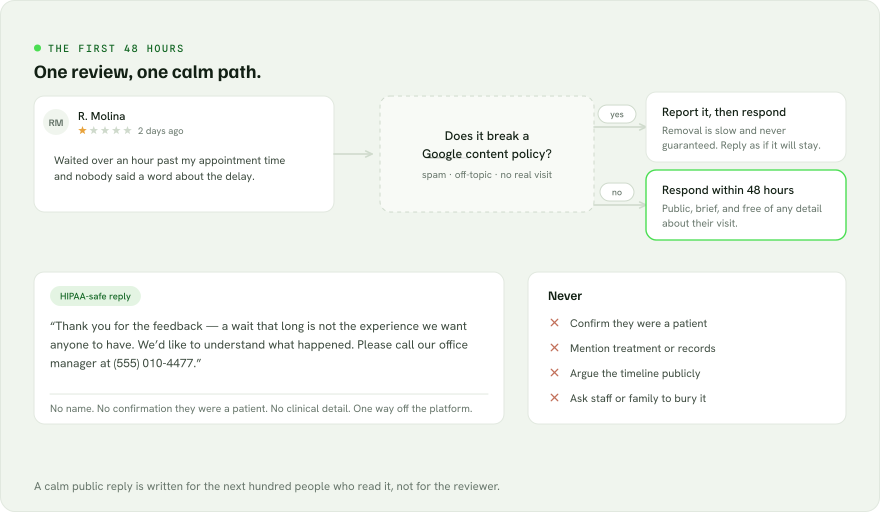
2. Respond calmly, briefly, and take it offline
The goal of a public reply isn’t to win the argument; it’s to show the next hundred prospective patients reading it that you’re professional and you care. A safe, effective response does three things: thanks them for the feedback, expresses a general commitment to patient experience without confirming specifics, and invites them to continue privately.
Something like: “Thank you for taking the time to share this. We take all feedback about our patients’ experience seriously and would welcome the chance to speak with you directly; please reach our office manager at [phone/email].” Calm, generic, no PHI, and it moves the real conversation off the public page.
3. Then actually resolve it privately
The public reply is the storefront; the private conversation is where the problem gets solved. Reaching out directly gives you a chance to understand what happened, make it right where you can, and, often, earn an updated or removed review from a patient who simply felt unheard.
4. Know when a review can be removed
You can’t get a review taken down just for being negative. But Google will remove reviews that violate its policies, and a surprising number qualify: reviews from people who were never patients, posts with profanity or hate speech, spam, conflicts of interest (a competitor or a former employee), or content that has nothing to do with your practice. If a review clearly breaks the rules, flag it through Google and submit a calm, factual removal request. Don’t expect miracles, but legitimate policy violations do come down.
You rarely win by arguing with one review. You win by making it a small, old data point next to a steady stream of recent, genuine ones.
5. The best defense is volume and recency
Here’s the strategic truth: a single one-star review is devastating when you have twelve reviews, and almost invisible when you have three hundred recent ones. The most reliable way to neutralize the occasional bad review is to be consistently collecting good ones, so your rating reflects the experience of your many happy patients rather than your loudest unhappy one. (We covered the targets in how many reviews your practice really needs.)
This is also where a system beats willpower. A HIPAA-conscious review platform makes asking every patient part of the routine, so fresh reviews keep flowing and the occasional negative one is diluted by a steady current of genuine ones. Just make sure you ask everyone the same way: screening patients and sending only the happy ones to Google is review gating, which Google prohibits.
The takeaway
A negative review feels personal, but your response shouldn’t be. Stay calm, never reveal anything about the patient or their care, move the real conversation private, seek removal only when there’s a genuine policy violation, and above all, keep collecting honest reviews so no single voice defines your reputation. Handled this way, the occasional bad review becomes a footnote, not a crisis.