Most practices serve a region, not a single ZIP code. Patients come from the surrounding towns, the suburb next door, the community just across the highway. But search doesn’t work that way by default: when someone searches from a neighboring town, Google leans heavily on proximity, and a practice physically located in their town usually gets the nod, even if you’re the better provider a short drive away.
The good news is that proximity is only one of three local ranking factors. You can’t move your building, but you can strengthen the other two (relevance and prominence) enough that Google extends your reach into the areas you actually serve.
First, the thing you should never do
The tempting shortcut is to fake it: create fake addresses, rent a virtual office, or stuff town names everywhere. Don’t. Google aggressively penalizes fake locations and “doorway” pages, and for a healthcare practice the reputational and compliance risk isn’t worth it. Everything below is about earning a wider radius, not tricking your way into one.
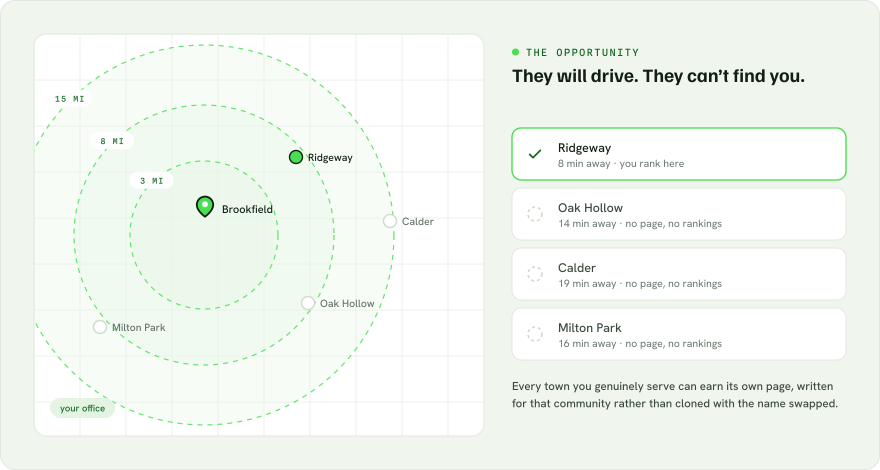
1. Build a genuine page for each area you serve
This is the single biggest lever. For each town or neighborhood you want to reach, create a real, substantial page on your website about serving patients there, not a copy-paste template with the town name swapped in, but a genuinely useful page: the services you provide those patients, directions and travel context, conditions common to that community, local insurance you accept, real specifics.
Done well, these service-area pages give Google a legitimate reason to associate your practice with those towns. Done lazily (thin, duplicated pages), they do nothing or actively hurt. The difference is whether the page would be useful to a real patient from that town.
2. Set your service areas and categories in Google
Your Google Business Profile lets you define the areas you serve. Set them accurately to the towns you actually cover. Combine that with the correct primary and secondary categories (the relevance backbone we cover in why your practice isn’t in the Map Pack), and you’ve told Google clearly who you serve and where.
3. Earn reviews that mention the surrounding areas
When patients from neighboring towns mention their experience (naturally, in their own words), those signals help Google understand the breadth of your patient base. You can’t script reviews (and you shouldn’t reference any treatment details), but a steady, compliant flow of reviews from across your region quietly reinforces your reach. That’s exactly what a consistent review system keeps running.
4. Become more authoritative than distance
Here’s the part most practices miss: when Google is confident a business is the most relevant, trusted, complete answer for a search, it will show that business across a wider radius; distance matters less when prominence is high. Authority is built through everything compounding together: a well-structured site, consistent citations, fresh reviews, and ongoing content. The stronger your overall presence, the further it carries.
You don’t beat proximity by faking an address. You beat it by being so clearly the best answer that Google extends your radius for you.
5. Publish content that speaks to the wider region
Local content (articles that answer questions for patients across your service area) reinforces the geographic relevance of your whole site. Over time this feeds both classic search and the AI answers patients increasingly rely on when they ask “best [specialty] near [town].”
The honest timeline
Expanding your radius is a months-long effort, not a switch. Proximity is a real and persistent factor, so you won’t outrank a good local competitor in their own backyard overnight. But methodically (real area pages, accurate profile settings, steady reviews, and growing authority), practices regularly grow from “only found in our home city” to ranking across an entire region. The patients were always willing to drive. This is how they finally find you.